As global agriculture evolves toward precision, efficiency, and sustainability, controlled-release fertilizers (CRF) are gradually replacing some traditional chemical fertilizers and have become a major trend in modern agriculture.
Compared to traditional chemical fertilizers, which release nutrients all at once, controlled-release fertilizers release nutrients continuously and evenly. This effectively reduces the frequency of fertilization, improves nutrient utilization, and minimizes resource waste and environmental pollution caused by nitrogen volatilization and leaching.
As the most widely used nitrogen fertilizer globally, urea—with its high nitrogen content of 46%, excellent granule strength, good coating properties, and high cost-effectiveness—has become the most ideal and commonly used core raw material in the production of controlled-release fertilizers.
Urea coating systems have evolved from a niche technology into a cornerstone of global sustainable crop management. With the global nitrogen use efficiency (NUE) of traditional urea hovering at a disappointing 30% to 40%, the engineering technology behind controlled-release fertilizers (CRFs) offers solutions to the problems of nitrogen leaching, ammonia volatilization, and greenhouse gas emissions.
The performance of a urea coating system is fundamentally defined by its “Coating Liquid.” Below is a technical breakdown of the seven core elements currently driving the global CRF market.
1.1 Sulfur (S): The Dual-Purpose Nutrient Barrier
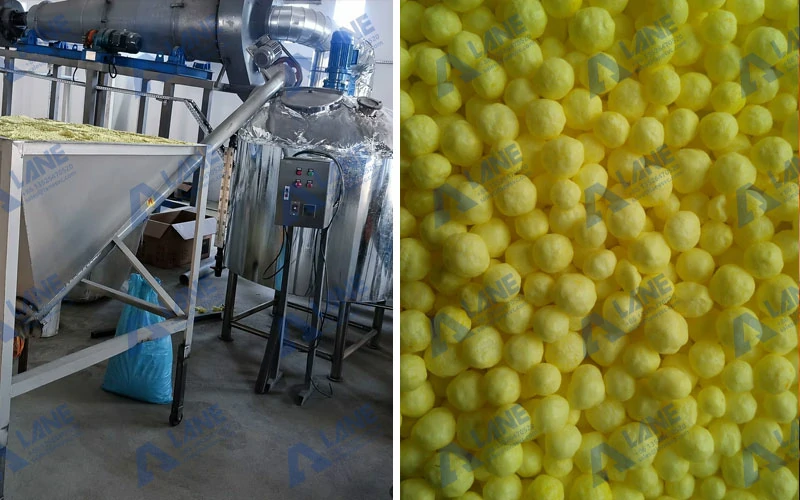
Sulfur-Coated Urea (SCU) is the foundation of the controlled-release industry. Molten sulfur is applied to urea granules to form a hard, hydrophobic shell.
1.2 Polyurethane (PU): The Precision Engineering Standard
Polyurethane represents the high-tech tier of the urea coating system, utilizing a thermosetting reaction between isocyanates and polyols.
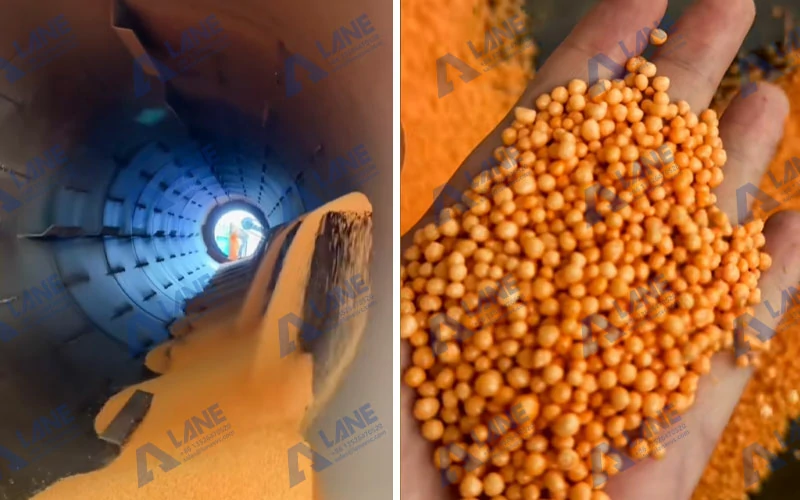
1.3 Neem Oil: The Biological Nitrification Inhibitor
Neem-Coated Urea (NCU) utilizes the natural chemical properties of the Neem tree (Azadirachta indica) rather than a pure physical barrier.
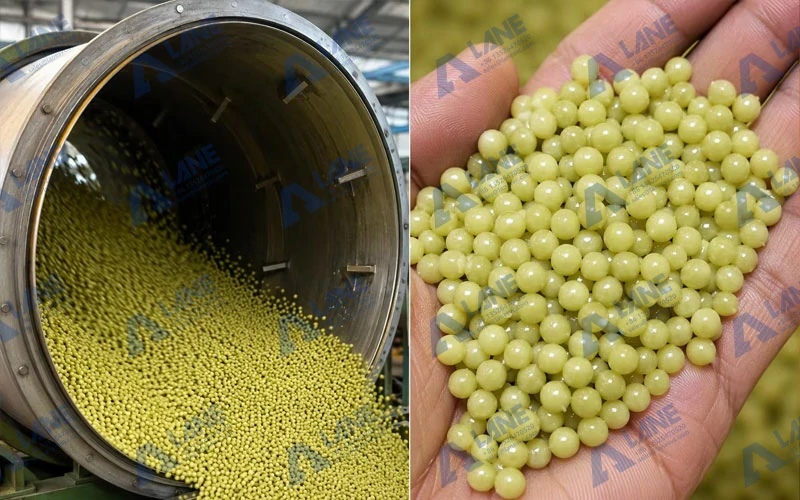
1.4 Humic Acid: The Organic Synergy Layer
Humic acid is increasingly used in multi-layer urea coating systems to combine fertilization with soil conditioning.
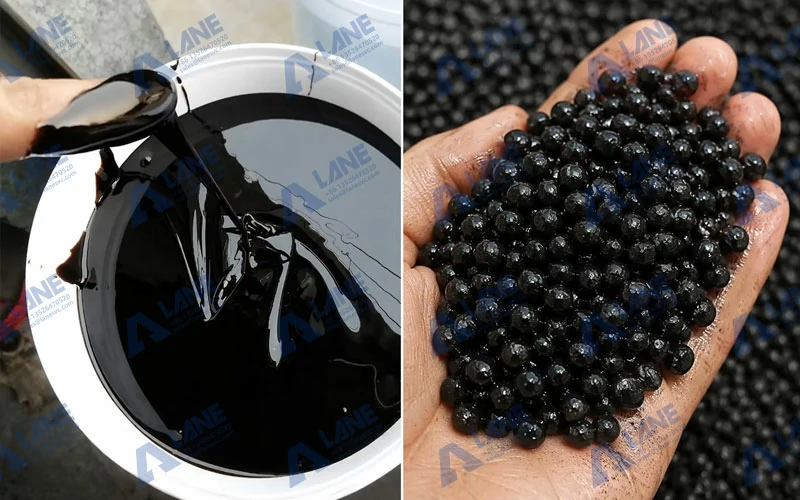
1.5 Lignin: The Sustainable Bio-Polymer
Lignin, derived from wood pulp, is the industry’s answer to the microplastic crisis.
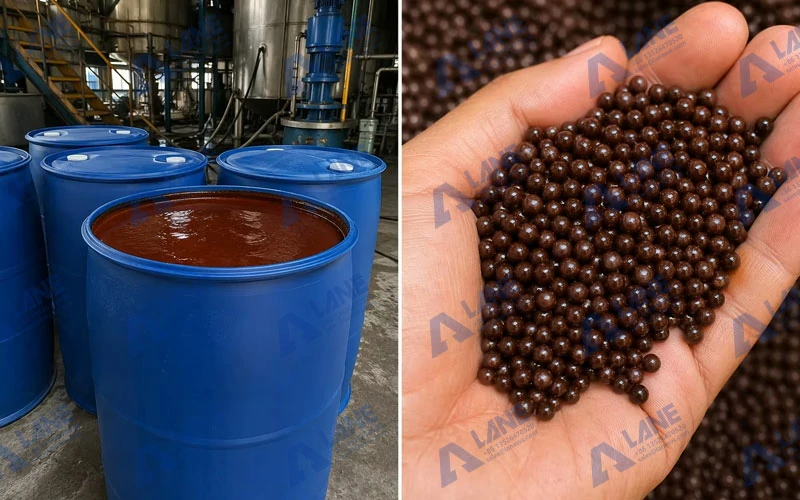
1.6 Paraffin Wax: The Critical Hydrophobic Sealant
Wax is the “unsung hero” of the SCU process, typically used as a secondary sealant.
1.7 Synthetic Resins: The Durable Barrier
Resins (including Polyethylene, Polystyrene, and Polylactic Acid) offer the most durable physical barrier in the industry.
The transition from a raw coating liquid to a high-performance controlled-release membrane requires a precise intersection of chemical engineering and mechanical precision. A high-tier Urea Coating System must adapt its thermal and mechanical parameters to the specific rheology and curing characteristics of the materials used—whether it is the molten heat of sulfur or the delicate chemical reaction of polyurethane.
Different coating materials of urea coating system demand vastly different industrial handling environments to ensure membrane integrity and prevent “clumping” or “burst release” flaws.
2.1 Thermal Management for Sulfur and Wax
Sulfur and Paraffin Wax are applied in a molten state. The industrial challenge lies in maintaining the “Goldilocks” temperature range.
2.2 Reaction Control for Polyurethane and Resins
Polymer coatings like PU are not “melt-applied” but rather “reaction-applied.”
2.3 Emulsification for Neem and Humic Acid
These biological agents are often applied as aqueous or oil-based emulsions.

To achieve industrial-scale efficiency, three primary equipment architectures dominate the global landscape.
3.1 The Advanced Rotary Drum Coater (High-Volume Continuous)
This is the workhorse for Sulfur-Coated Urea (SCU) and high-throughput production lines.

3.2 Fluidized Bed and Spouted Bed Systems (Precision Thin-Film)
For high-end Resin and PU-coated urea, the Fluidized Bed is superior.
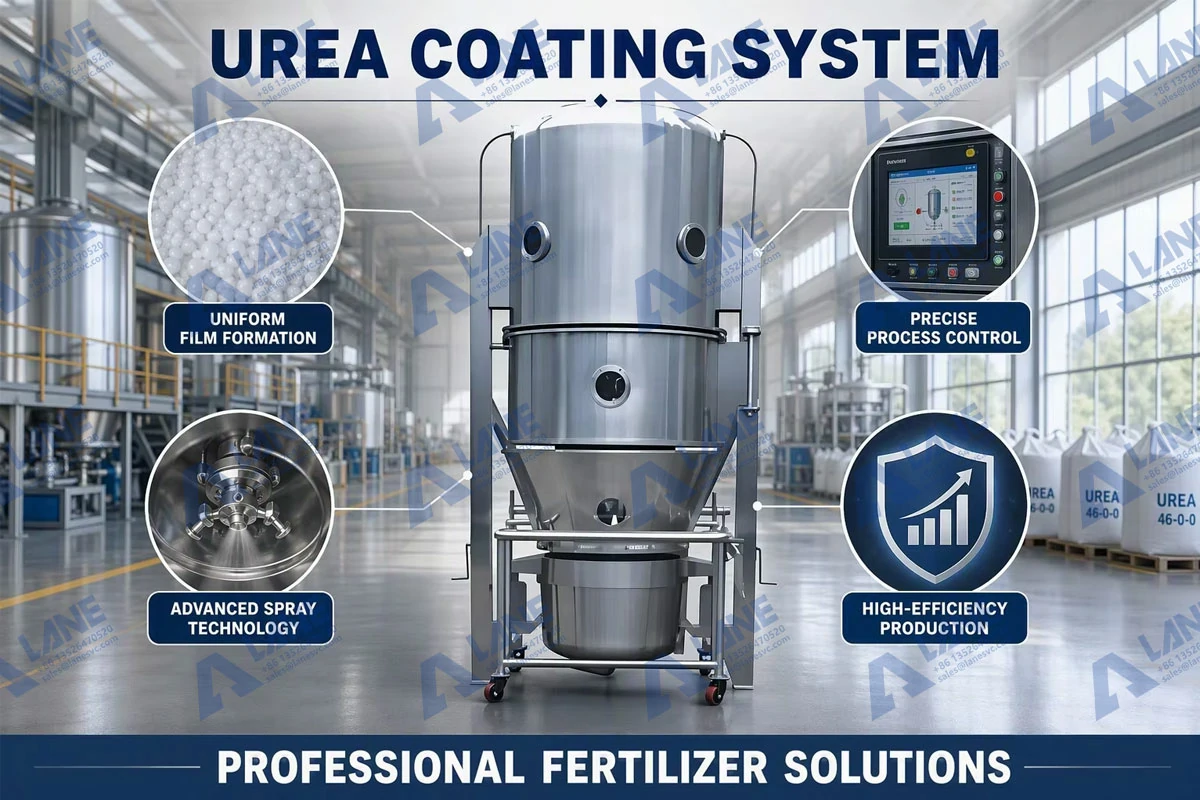
3.3 High-Precision Spraying and Atomization Nozzles
The nozzle is the “heart” of the urea coating system.
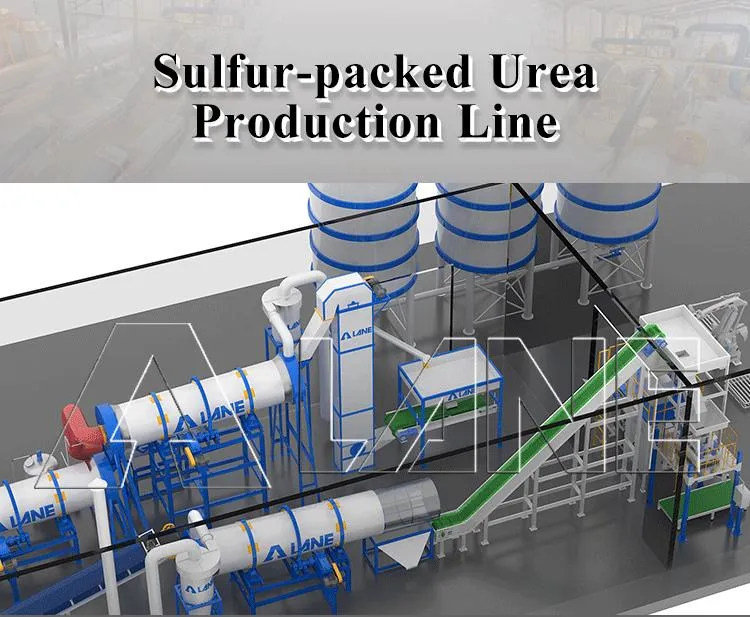
The industrial urea coating production line follows a rigorous sequence to ensure high EEAT standards and product reliability.
Industrial Production Workflow
1
Screening & Dust Removal
Ensures only uniform granules (2-4.75mm) enter the system; removes fine dust that compromises coating adhesion.
↓
2
Granule Pre-heating
Crucial step. Urea is heated to 60°C–80°C to prevent “thermal shock” and ensure the coating liquid spreads smoothly.
↓
3
Multi-Layer Coating Application
Coating liquids are atomized and applied. For PSCU, sulfur is applied first, followed by polymer sealant.
↓
4
Curing & Cooling
Film is stabilized in a cooling drum or fluidized cooler to reach ambient temperature before bagging.
Key Data Support: Industrial Efficiency Parameters
As the global fertilizer industry pivots from “volume” to “value,” the Urea Coating System has become the epicenter of strategic investment. In a world defined by carbon taxes, labor shortages, and soil health mandates, the choice of coating technology is no longer just a technical decision—It is a capital strategy that will determine the company’s survival over the next decade.
Chapter 4: Strategic Investment and ROI Analysis
Investing in a urea coating system requires balancing Capital Expenditure (CAPEX) with the specific demands of the target market.
Strategic Investment Analysis (2026-2030)
| Technology | CAPEX Tier | Premium Margin | Ideal ROI Scenario |
| SCU (Sulfur/Wax) | Low – Mid | 10% – 15% | Broad-acre commodity crops (Wheat, Corn) |
| PCU (Polyurethane) | High | 35% – 50% | High-value horticulture & luxury turf |
| Hybrid (PSCU) | Medium | 20% – 25% | Export-grade cash crops (Sugar, Coffee) |
| Bio-Polymer | High | 40% ++ | ESG-compliant markets (EU/North America) |
4.1 Investment Roadmap for Manufacturers
The market for coated urea is undergoing a fundamental shift driven by three macro-drivers:
5.1 The “One-and-Done” Farming Model
With rural labor shortages intensifying globally, farmers are increasingly seeking “single-application” solutions. A high-efficiency urea coating system allows for a basal application that covers the entire growing season, reducing labor costs by 40%–60%. This trend is particularly strong in the aging farming populations of Japan, China, and Western Europe.
5.2 Regulatory Pressures and Nitrogen Quotas
The European Chemicals Agency (ECHA) and similar bodies in North America are tightening regulations on nitrogen runoff. In some regions, farmers are being incentivized (or forced) to use CRFs to meet “Nitrogen Budgets.” This regulatory tailwind is creating a guaranteed demand for manufacturers with certified urea coating systems.
The “Elephant in the room” for the urea coating system is the Microplastic Legacy. Traditional PE and PP coatings leave synthetic shells in the soil.
6.1 The Transition to Bio-Degradable Materials
The next generation of coatings will be defined by materials that vanish once their job is done.
6.2 Carbon Credits and Nutrient Stewardship
Advanced urea coating systems are now being integrated into Carbon Credit Programs. By reducing N2ON2O emissions (a gas 300 times more potent than CO2CO2), manufacturers can potentially generate carbon offsets. This creates a new revenue stream where the environmental benefit of the coating pays for the technology itself.
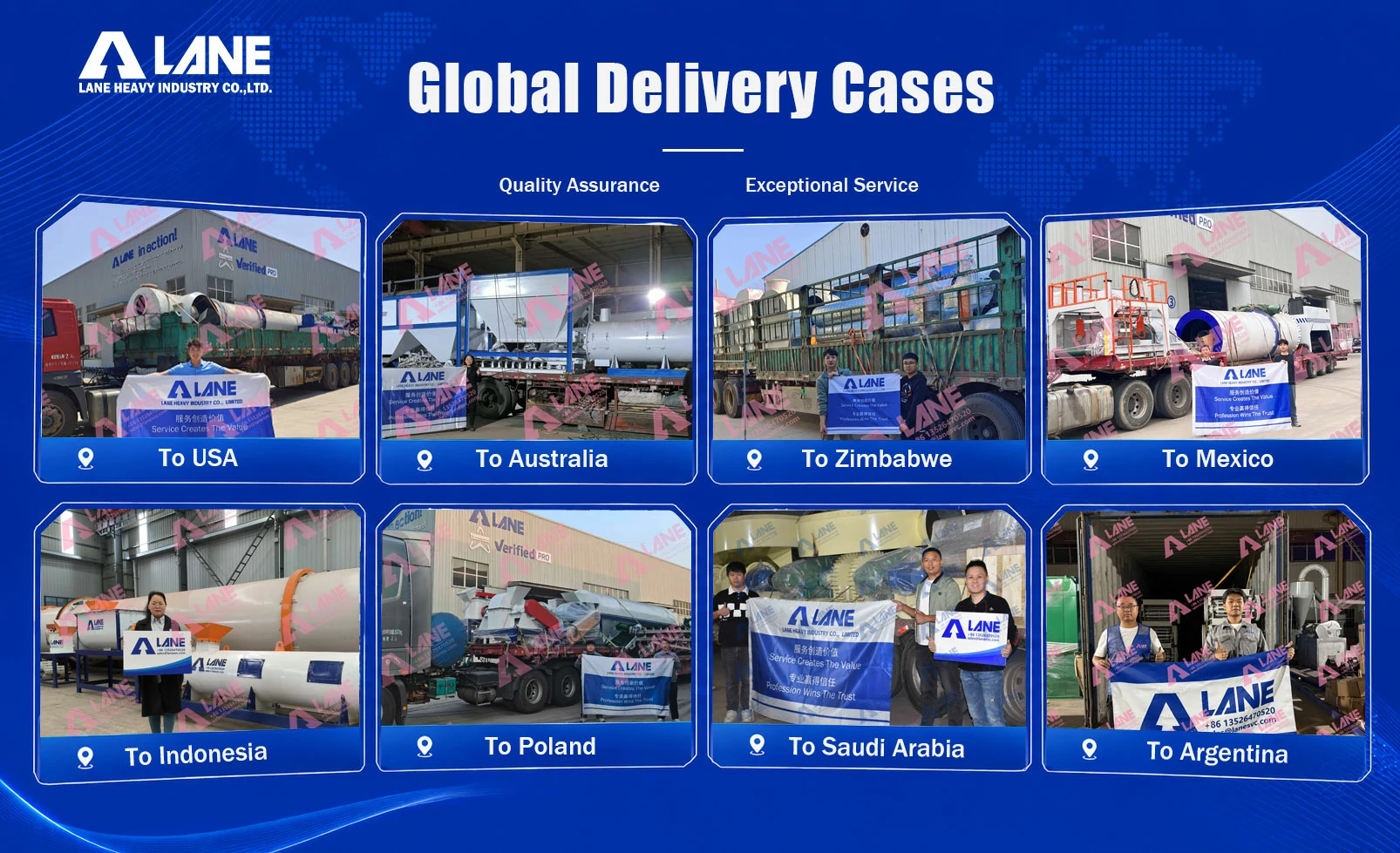
To implement a world-class Urea Coating System, manufacturers require more than just machinery; they need a strategic engineering partner. LANE (Lane Heavy Industry) has established itself as a global leader in providing integrated solutions for the controlled-release fertilizer industry.
LANE’s service portfolio is designed to bridge the gap between lab-scale chemistry and industrial-scale profitability through the following core offerings:
7.1 Turn-key Engineering & Plant Design
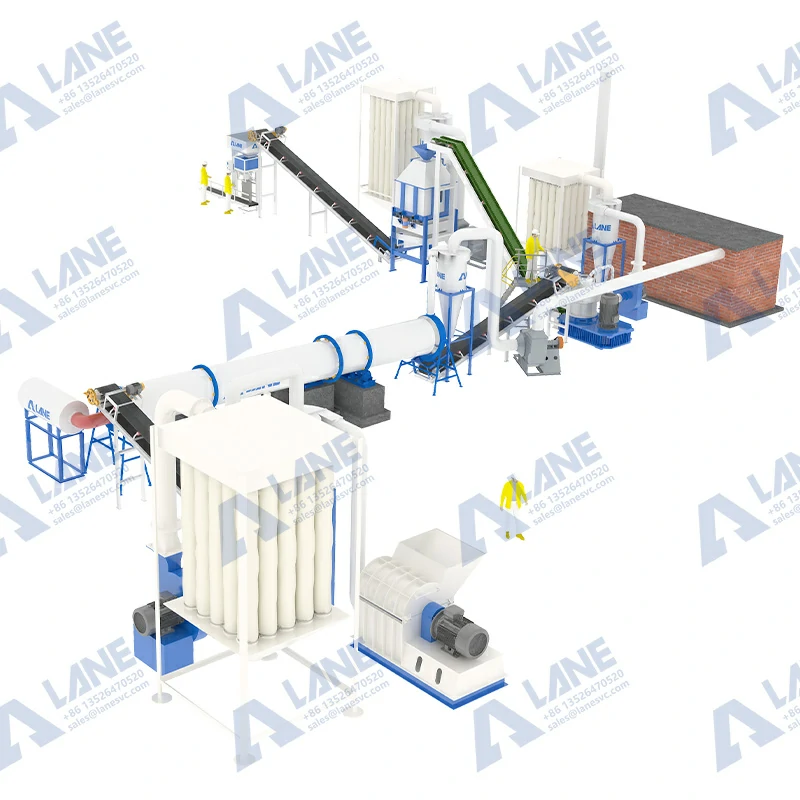
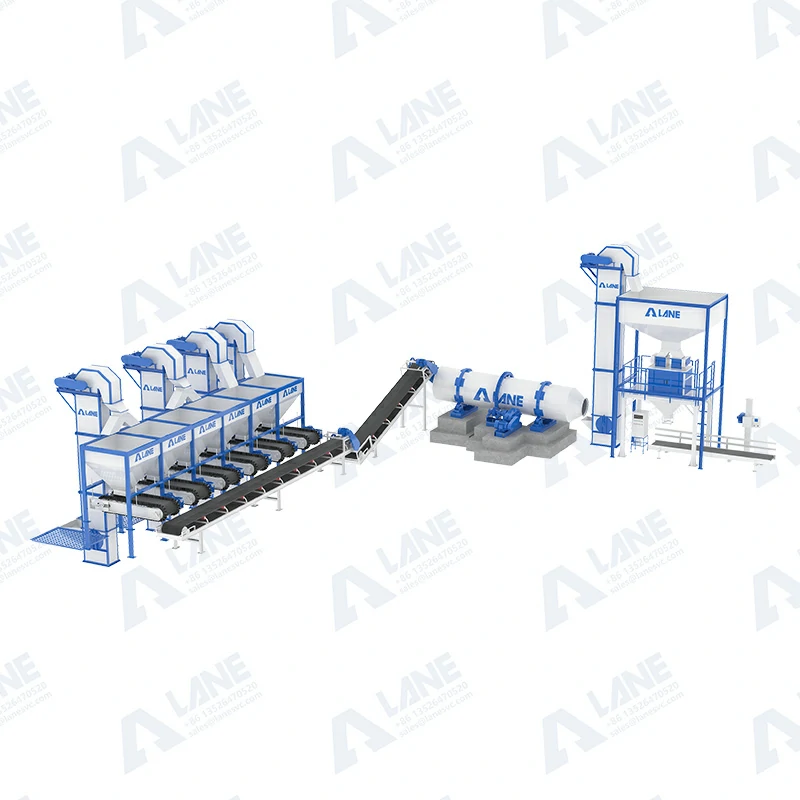
LANE provides comprehensive EPC (Engineering, Procurement, and Construction) services of Urea Coating System. From initial site survey and flow-sheet design to the installation of high-capacity rotary drums and fluidized beds, LANE ensures that the entire production line is optimized for thermal efficiency and material throughput.
7.2 Customized Coating Liquid Integration
Every market has unique agronomic needs. LANE’s technical team assists clients in calibrating their systems for specific coating palettes—whether it is the molten application of Sulfur and Paraffin Wax, the complex reaction of Polyurethane, or the emulsification of Neem Oil and Humic Acid. Their systems are built with the flexibility to switch between different coating agents with minimal downtime.
7.3 Advanced Automation & IoT Monitoring
In line with Industry 4.0, LANE integrates smart sensors into the urea coating system. These sensors monitor granule bed temperature, spray atomization pressure, and curing rates in real-time. This data-driven approach allows for a Coefficient of Variation (CV) < 5%, ensuring that every bag of fertilizer meets the promised release duration.
7.4 ESG & Biodegradability Consultation
As global regulations pivot toward a microplastic-free future, LANE provides specialized consulting on transitioning existing lines to handle Lignin-based and biodegradable Resin coatings. Their R&D support helps manufacturers stay ahead of ECHA and REACH compliance while maintaining cost-efficiency.
Conclusion: The Strategic Outlook
The Urea Coating System is no longer a peripheral additive process—it is the technological linchpin of 21st-century nutrient stewardship. By partnering with experts like LANE, fertilizer producers can achieve a rare “Triple Win”: Economic Profitability, Agronomic Excellence, and Environmental Protection.
Conclusion: The Strategic Outlook
The Urea Coating System is no longer a peripheral additive process—it is the technological linchpin of 21st-century nutrient stewardship. For fertilizer companies, the path forward involves:
By investing in advanced coating systems, partnering with experts like LANE Heavy Industry Technology, fertilizer producers can achieve a rare “Triple Win”: Economic Profitability, Agronomic Excellence, and Environmental Protection.
In this article, a senior engineer from LANE Heavy Industry Technology will guide you through the core elements of modern urea coating systems: advanced coating solutions, specialized industrial equipment, and the investment prospects in this market.