News
Home / News

Engineering High-Concentration Fluid Nutrition: How LANE Achieved a Breakthrough in Suspension Fertilizer Production Lines

10-29 2026

author: Zero Shen

from: LANE Machinery Groups

Suspension Fertilizer Production Line: Overcoming the Limitations of Traditional Liquid Fertilizer

In modern precision agriculture and large-scale fertigation, liquid nutrition is in high demand for its rapid absorption and effortless application. However, conventional clear liquid fertilizers face a major physical barrier: the solubility ceiling. Standard water-soluble blends generally cannot exceed 30% to 35% total nutrient concentration (N+P2O5+K2O) without crystallizing or precipitating during cold weather.

To supply high-analysis formulations (reaching 45%–60% total active nutrients) while seamlessly incorporating insoluble micronutrients, micronized sulfur, and organic bio-stimulants (such as humic acids and seaweed extracts), commercial fertilizer producers are transitioning to Suspended Fertilizers (Fluid Suspension Fertilizers).

Manufacturing high-grade suspended fertilizers requires specialized industrial machinery. Unlike simple blending tanks, a true Suspension Fertilizer production line must achieve ultra-fine liquid dispersion and long-term shelf stability—ensuring that dense solid particles stay evenly suspended in liquid without settling into hard sediment or clogging application nozzles.

Recently, thanks to the tireless efforts of LANE’s engineers, a breakthrough was achieved for a new product: we successfully completed its first customized turnkey design for a suspension fertilizer production line, meeting the client’s needs and marking the first such endeavor in the field of high-concentration suspension fertilizer machinery.

1. The Client Challenge: Why Generic Blending Equipment Failed

A leading agricultural enterprise approached LANE seeking to expand into high-value suspension fertilizers. While operating conventional dry blending and clear liquid lines, the client faced critical commercial hurdles:
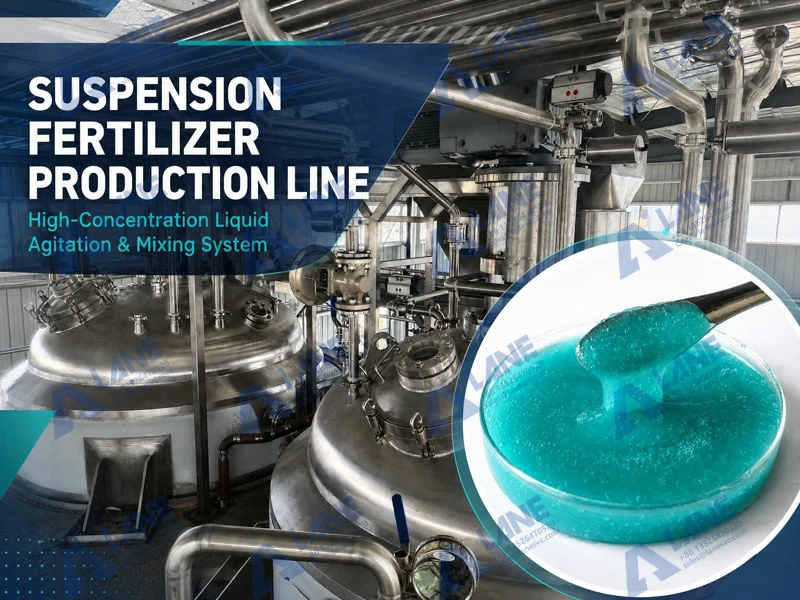
  1. High Logistics & Packaging Costs: Shipping low-concentration clear liquids (which contain 65%–70% water) resulted in excessive freight expenses and inflated packaging costs per unit of nutrient.
  2. Formula Limitations: Existing mixing tanks could not incorporate insoluble or low-solubility ingredients—such as zinc oxide, potassium humate, micronized sulfur, and insoluble phosphate—into a stable liquid product.
  3. Severe Storage Sedimentation: Previous attempts using standard agitators caused severe product separation within two weeks, forming a dense, unpumpable “hard cake” at the bottom of storage IBC totes.
  4. Field Application Clogging: Inconsistent particle grinding repeatedly blocked customer drip emitters, center-pivot spray nozzles, and fine filtration screens.

Target Specifications Required by the Client

  • Target Output: 10 metric tons per hour (10 TPH) continuous automated production.
  • Formulation Versatility: High-nutrient balanced and high-potassium formulas (such as NPK 18-18-18 + 5% Humic Acid + Trace Elements, and high-phosphorus starter blends).
  • Application Reliability: 100% smooth flow through all commercial drip irrigation systems and agricultural spray nozzles with zero clogging.
  • Storage Stability: Long-term shelf stability (over 12 months) with no irreversible hard sedimentation across varying climate conditions.

suspension-fertilizer-production-line

2. LANE’s Custom Engineering Solution: Step-by-Step Production Process

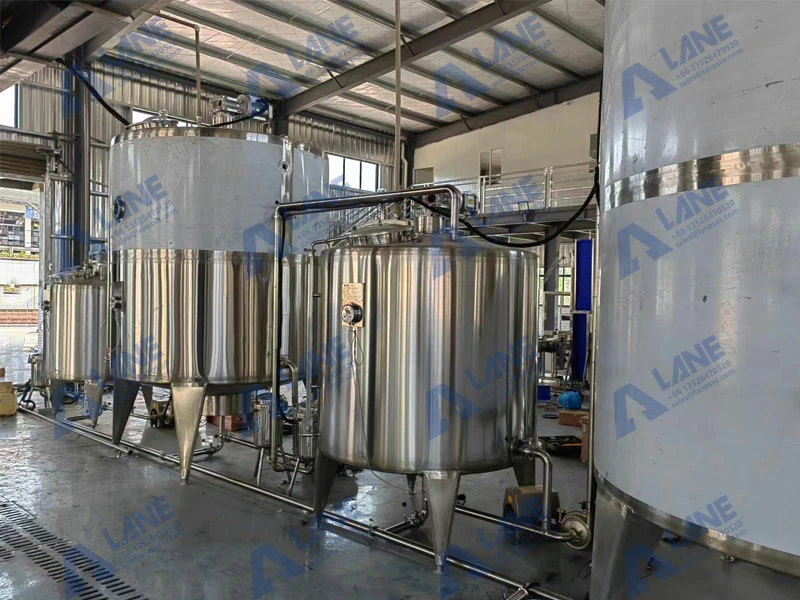
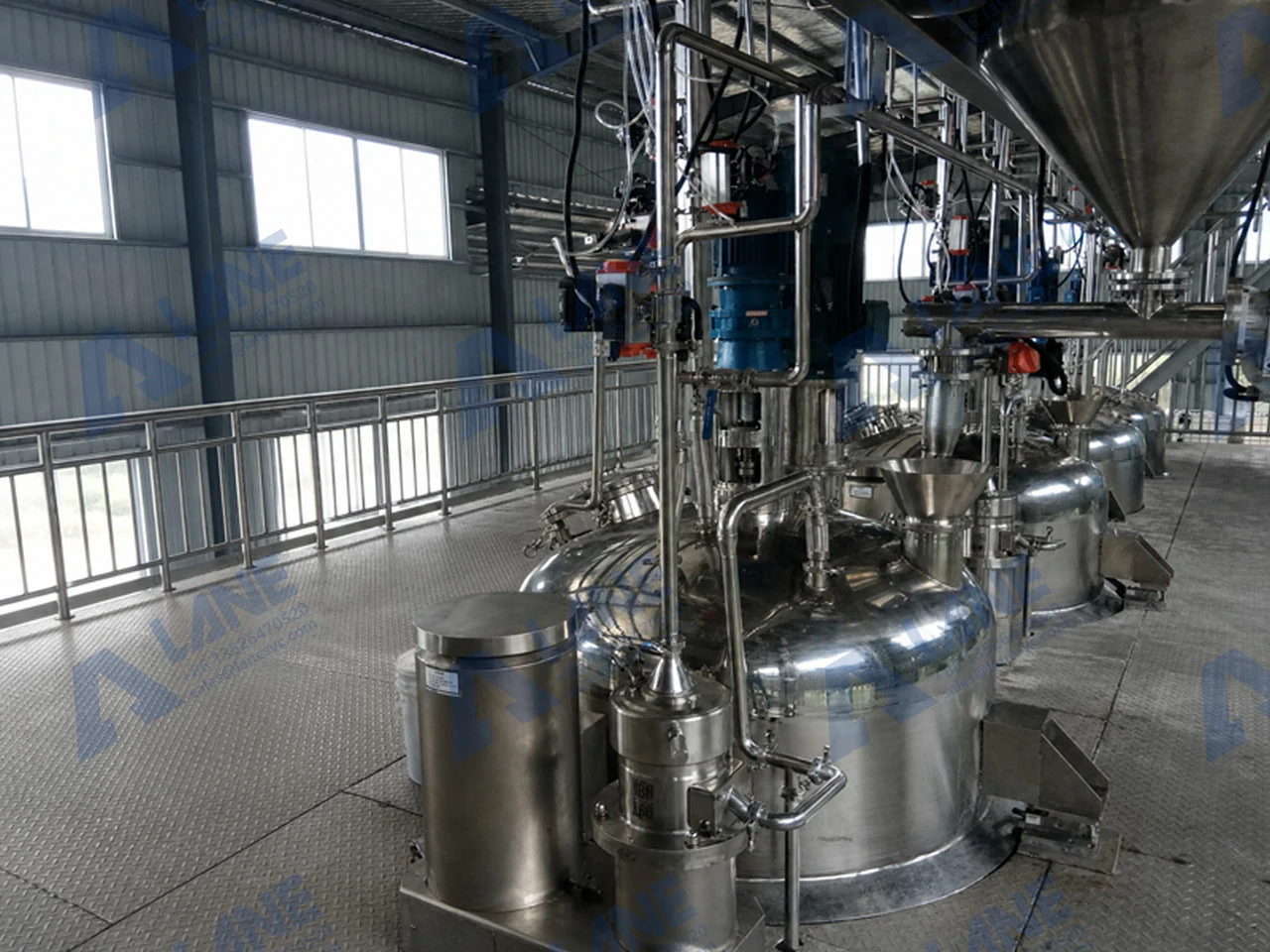
To meet these demanding standards, LANE replaced standard agitator configurations with a fully integrated, multi-stage processing system built from heavy-duty, corrosion-resistant stainless steel (SS316L).
Step 1: Automated Raw Material Batching & Dry Pre-Conditioning

  • Equipment: Multi-bin loss-in-weight gravimetric dosing units and high-speed dry pulverizers.
  • Process Function: Solid nutrients (urea, MAP, potassium salts) and suspending agents (specialized attapulgite clay and hydrocolloids) are continuously weighed with ±0.5% accuracy. Solid ingredients undergo fine pre-pulverization before entering the liquid stage, accelerating dissolving speed and easing downstream wet processing.

Step 2: High-Shear Colloid Dispersion & Matrix Activation

  • Equipment: Jacketed SS316L high-shear dispersion reactor with dual-motion agitation.
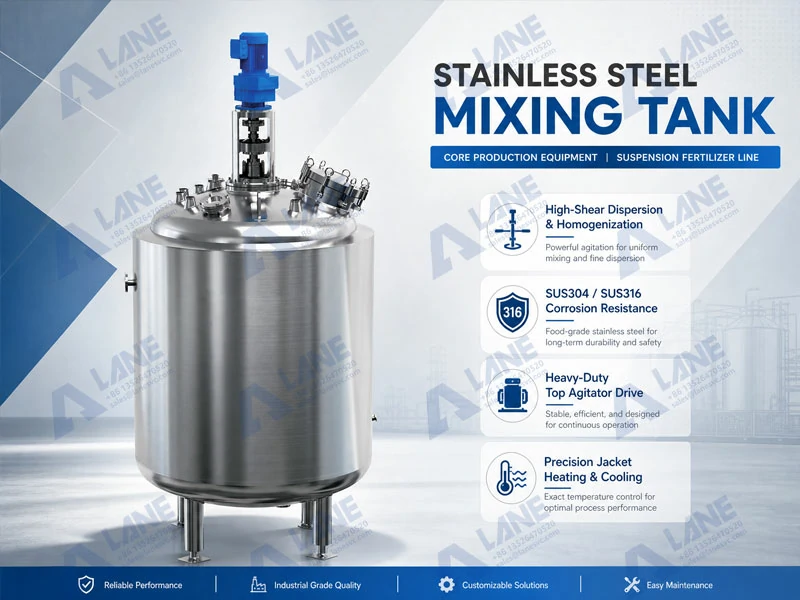
  • Process Function: Combining low-speed wall-scraping anchor blades (15–40 RPM) with a high-velocity rotor-stator shear turbine (1,450–2,900 RPM). This unit rapidly activates suspending agents, creating a uniform, three-dimensional gel lattice that holds dense nutrient particles suspended in the liquid matrix without forming unhydrated lumps.

Step 3: Multi-Stage In-Line Wet Micro-Milling & Homogenization

  • Equipment: Industrial continuous colloid mill paired with a heavy-duty horizontal wet grinding mill.
  • Process Function: The liquid mixture passes through high-precision micro-grinding chambers. Solid particles are refined into an ultra-fine, silky smooth emulsion. This eliminates coarse grains and ensures the final suspension fertilizer flows freely through all standard agricultural sprayers and drip lines.

Step 4: Temperature-Controlled Reaction & Deaeration

  • Equipment: Dimple-jacketed conditioning vessels with automated vacuum deaeration.
  • Process Function: High-speed shearing naturally generates frictional heat. LANE’s integrated cooling system maintains ideal reaction temperatures (35∘C–45∘C) to protect heat-sensitive bio-stimulants (amino acids and humic compounds). The continuous deaerator removes micro-bubbles, ensuring uniform product density and preventing foam buildup during packaging.

Step 5: Dual Self-Cleaning Filtration & Anti-Drip Automatic Bottling

  • Equipment: Dual-stage automated backwash filtration screens and multi-head servo piston filling lines.
  • Process Function: The finished liquid passes through automated protective filters before reaching the packaging line. The servo-driven piston filler features diving nozzles, anti-drip cutoffs, and continuous recirculating manifolds to ensure precise filling volume without splashing or nozzle crusting across 1L, 5L, 20L jerrycans and 1,000L IBC totes.

suspension-fertilizer-production-line

3. The Landmark First Breakthrough: How LANE Solved Key Production Bottlenecks

Developing LANE’s first industrial-scale 10 TPH suspension fertilizer production line required overcoming two critical engineering obstacles during pilot testing.

Breakthrough 1: Solving Suspension Instability in High-Salt Formulas

During initial batch trials, introducing high concentrations of potassium and ammonium salts caused standard suspending clays to lose their structure, leading to premature liquid thinning and rapid sedimentation.

  • LANE’s Engineering Solution: LANE developed a Synergistic Dual-Suspending System, combining modified attapulgite clay with food-grade stabilizing hydrocolloids. Furthermore, the PLC dosing sequence was re-engineered: suspending matrices are fully hydrated and activated under high shear before concentrated electrolyte salts are metered in via submerged distribution rings. This eliminated salt shock and ensured a robust, non-settling structure.

Breakthrough 2: Preventing Heat Buildup in Continuous High-Throughput Milling

Operating at a continuous 10 TPH capacity generated substantial friction inside the wet-milling loop. Excessive temperatures risked degrading organic bio-stimulants and destabilizing the liquid viscosity.

  • LANE’s Engineering Solution: LANE engineered an in-line titanium plate heat exchanger directly into the wet-milling recirculation loop. Linked to automated temperature sensors and chilled water valves, the system dynamically maintains product temperature below 38∘C even during continuous round-the-clock operation.

Breakthrough 3: Successful 72-Hour Factory Acceptance Test (FAT)

Following complete assembly and electrical integration, the 10 TPH suspension fertilizer production line completed a continuous 72-hour trial run at LANE’s heavy manufacturing facility:

  • Stable Output: Achieved a continuous processing rate of 10.4 TPH
  • Smooth Texture: The finished fertilizer displayed an ultra-fine, uniform liquid consistency with zero gritty residue.
  • Proven Anti-Caking: Accelerated thermal storage tests (equivalent to 12 months of ambient warehouse storage) confirmed zero hard sediment formation, maintaining complete suspension stability and effortless redispersibility.
  • Nozzle Compatibility: Tested across standard commercial drip tape emitters and agricultural spray tips with a 100% pass rate.

4. Performance Comparison: Clear Liquid vs. Conventional Mixing vs. Suspension fertilizer production Line

Evaluation Metric Traditional Clear Liquid Line Conventional Agitator Tank LANE Advanced Suspension Fertilizer Line
Max Nutrient Density (N+P2O5+K2O) 28% – 35% (Solubility limit) 35% – 40% (Easily separates) Up to 55% – 60% High Concentration
Organic & Insoluble Additions None (Solubles only) <3% (Causes heavy sediment) Up to 20% – 25% (Humic, Sulfur, TE, Seaweed)
Finished Liquid Texture Clear watery liquid Grainy, uneven liquid Silky smooth, ultra-fine emulsion
Storage Shelf Life High (Clear liquid) Poor (Hard cakes in 10–20 days) Excellent (>12 months anti-settling stability)
Spraying & Drip Safety Good High risk of nozzle clogging 100% smooth flow through all drip emitters
Automation & Process Control Basic manual control Manual timing & mixing Full PLC automated closed-loop operation
Equipment Metallurgy Standard SS304 SS304 or Carbon Steel Corrosion-resistant SS316L / Titanium

suspension-fertilizer-production-line

5. Technical Specifications: LANE Turnkey Plant Capabilities

LANE supplies complete, custom-engineered suspension fertilizer plants with capacities tailored to regional market demand.

Specification Parameter Standard Engineering Data
Production Capacity Options 3 – 5 TPH (Modular) | 10 – 15 TPH (Standard) | 20 – 30 TPH (Commercial)
Compatible Raw Materials Urea, Ammonium Polyphosphate, Potassium Nitrate/Sulfate, MAP, Humic Acid, Micronized Sulfur, Zinc Oxide, Trace Element Chelates, Attapulgite, Stabilizing Polymers
Finished Product Viscosity 600 – 2,000 mPa⋅s (Thixotropic easy-flow liquid)
Finished Liquid Specific Gravity 1.30 – 1.65 g/cm3
Wetted Material Metallurgy Industrial Stainless Steel 316L / Wear-Resistant Titanium / Alloy Steel
Control Automation Siemens S7-1500 / Allen-Bradley PLC with Full-Color Touchscreen & SCADA
Packaging Line Options 1L–5L Bottles/Jerrycans, 20L–200L Drums, 1,000L IBC Totes
Total Connected Power (10 TPH) Approximately 140 kW – 180 kW (Optimized for energy efficiency)

6. Business Value & Financial ROI for Fertilizer Manufacturers

Investing in a purpose-built suspension fertilizer plant unlocks significant commercial advantages:

  1. Substantial Logistics & Storage Savings: Doubling nutrient concentration from 30% to 60% cuts freight costs, plastic container expenses, and storage footprint by 40% to 50% per unit of nutrient delivered.
  2. Higher Profit Margins: High-concentration fluid suspension fertilizers command strong market premiums because they combine macro-nutrients and bio-stimulants in a single, easy-to-apply product.
  3. Flexible Formulation Sourcing: Manufacturers can utilize economical solid technical-grade raw materials and insoluble minerals rather than relying exclusively on high-cost, fully-soluble chemical salts.
  4. Fast Capital Payback: With robust market demand and reduced operating overhead, typical turnkey plants achieve full capital expenditure (CAPEX) payback within 7 to 12 months.

7. LANE’s End-to-End Turnkey EPC Services

From initial formulation testing to commercial suspension fertilizer plant handover, LANE provides comprehensive engineering support:
  • Raw Material & Formulation Testing: In-house laboratory evaluation of client raw materials and custom stabilizing formulation support.
  • Custom Plant 3D Layout & P&ID Engineering: Optimized facility layouts designed for efficient material handling, safety, and seamless expansion.
  • Precision In-House Manufacturing: Strict quality control, certified welding, dynamic balancing, and comprehensive pre-shipment testing.
  • On-Site Installation, Commissioning & Training: Experienced mechanical, chemical, and automation engineers deploy globally to oversee installation and train local operators.

suspension-fertilizer-production-line

Frequently Asked Questions (FAQ)

Q1: What makes suspension fertilizer different from standard clear liquid fertilizer?

Standard clear liquid fertilizers can only dissolve water-soluble salts and are limited to lower concentrations (typically under 35% total nutrients). Suspension fertilizers utilize high-shear dispersion and wet micro-milling to hold insoluble minerals and ultra-high nutrient loads (up to 60%) in a stable, easily pumpable liquid form.

Q2: How does LANE ensure the product will not clog agricultural sprayers or drip lines?

LANE utilizes a multi-stage refining process combining pre-grinding, high-shear colloid dispersion, and in-line wet micro-milling, followed by dual automated self-cleaning filters. This eliminates coarse particles and agglomerates, ensuring the liquid flows smoothly through standard drip irrigation emitters and spray nozzles.

Q3: How does the production line prevent hard settling during winter or prolonged storage?

LANE’s proprietary formulation and dual-action agitation system build a stable, thixotropic gel matrix. At rest, this matrix supports dense nutrient particles and prevents gravity settling; under pumping or shaking, the fluid thins instantly for effortless pouring and application.

Ready to Upgrade to High-Concentration Suspension Fertilizer Manufacturing?

Contact LANE’s engineering team today to discuss your project specifications, request customized equipment layouts, or arrange raw material testing.
Latest Post
hot products
New Type Organic Fertilizer Granulator New Type Organic Fertilizer Granulator
1-2T/H Cat Litter Production Line 1-2T/H Cat Litter Production Line
3-15T/H Compound Fertilizer Production Line 3-15T/H Compound Fertilizer Production Line